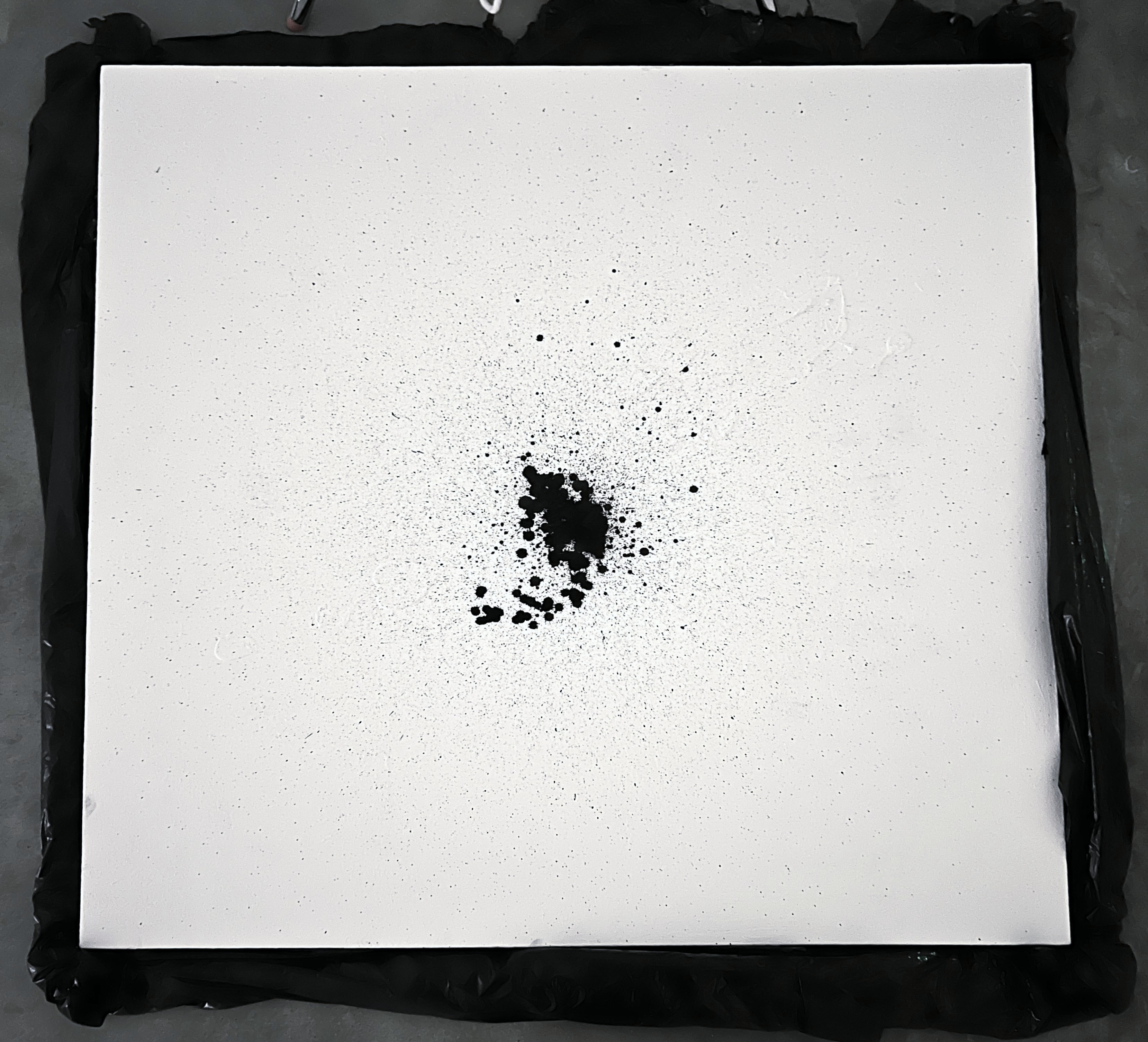
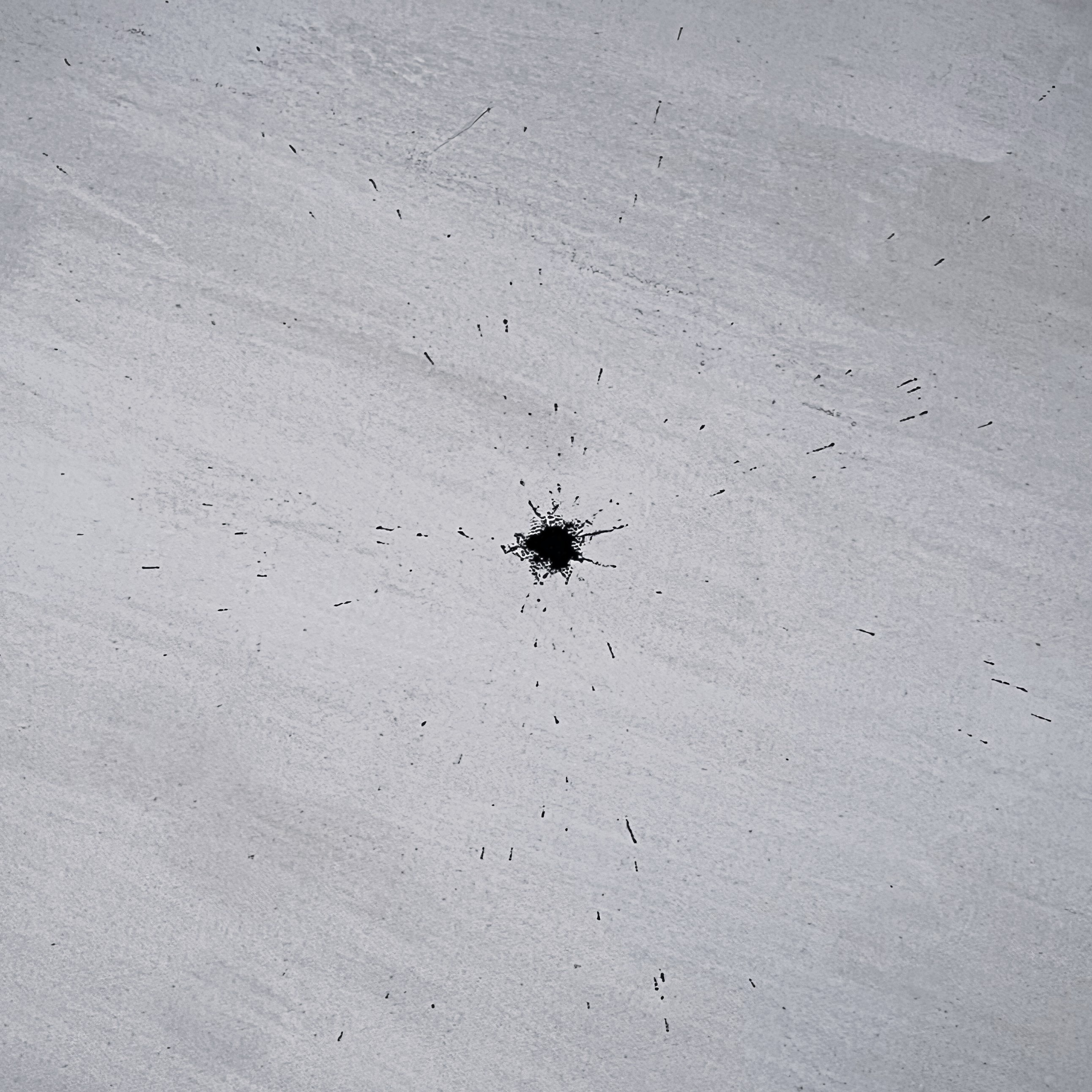
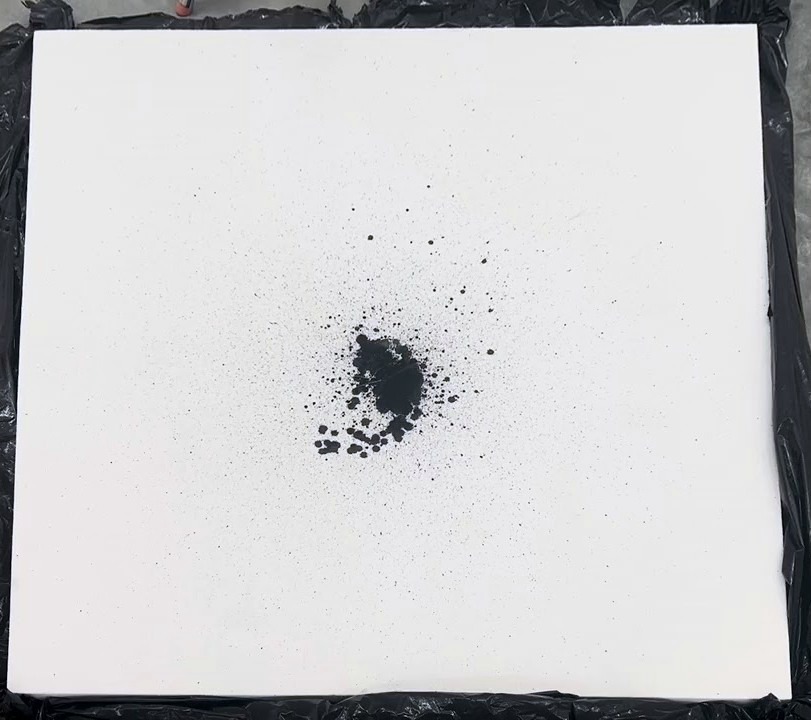
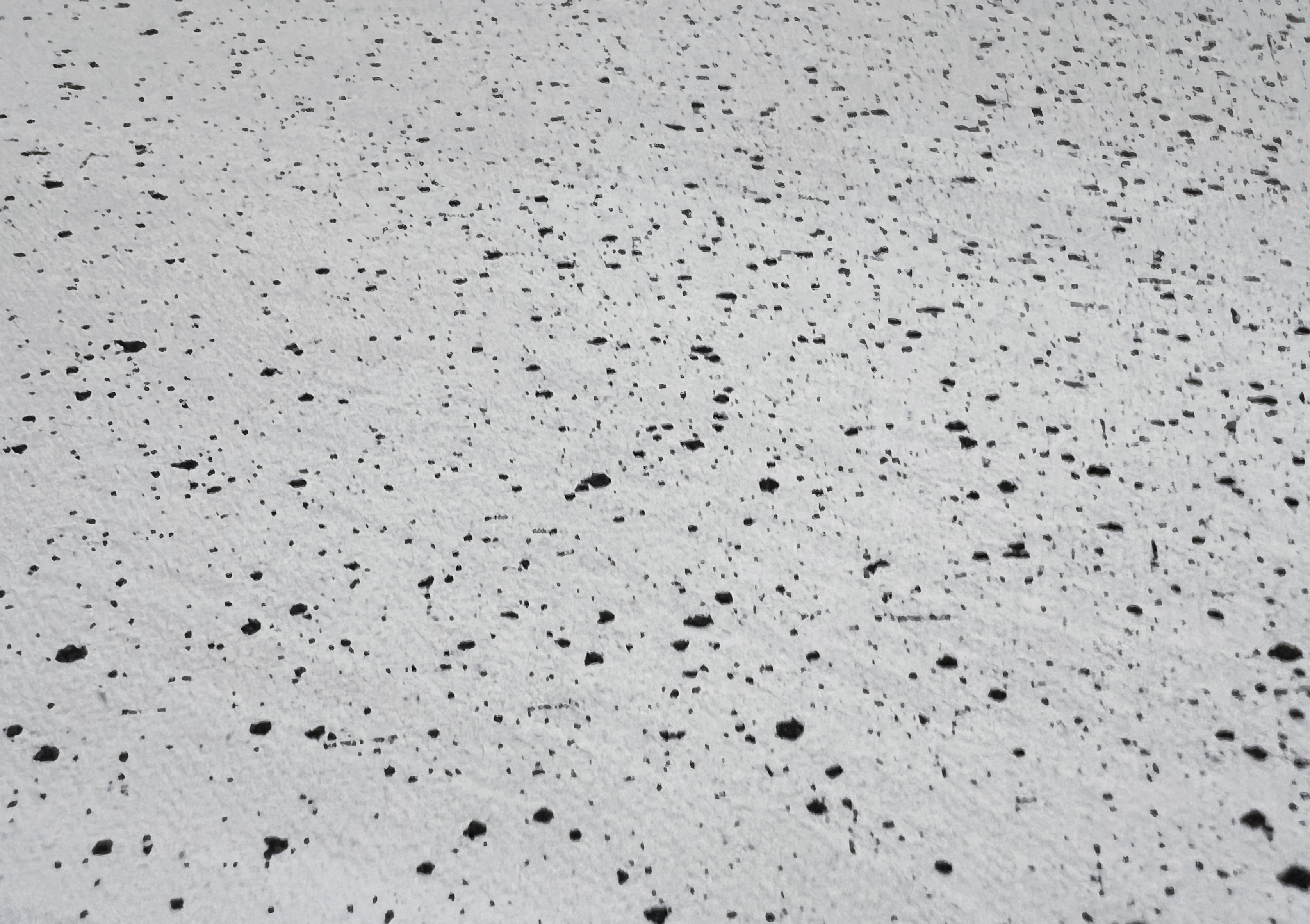
Ink Drip, 2025
India Ink, Canvas, Microcontrollers
Installation + Physical Generative Art: Ink drips onto a blank canvas
Installed at Harvard ArtLab, December 2025
Ink Drip is about maximal simplicity. Ink drips on canvas.
Generative art often requires complex algorithms and mechanisms, but often the simplest systems - Conway’s Game of Life, Go - are the most beautiful. By allowing complexity to be emergent rather than created, you see something about the underlying systems of the world that drive that complexity.
Ink Drip is simple, but fluid dynamics, kinematics, and pigmentation are not. What can we learn about the richness of the world by observing its simplest interactions?
Ink Drip is about a simple interaction, but creating that interaction was less simple.
The Idea
August 2025
When I began this project, it was with a very specific goal, which is unusual for me. I wanted to create a temporary installation that resulted in permanent generative art. A few weeks after expressing that desire to myself, I noticed how water dripped off a gutter after a flash rainstorm in Pittsburgh, which gave me the inspiration for what this project would look like.
That goal is important because it meant my priorities were shared between two things: creating something that looked good in the moment (the installation), and creating something that produced a good-looking final outcome (the result).
The piece was also inspired by a video by Solar Sands that I watched on long art, which is art that develops over extraordinarily long durations of time. It was in the context of that video that I interpreted the dripping gutter as an art piece.
Controlling the Drip
October 2025
A bag and a roller clamp
My original idea was to hold the ink in a gravity feeding bag (much like an IV bag), pipe it through a tube, and use the roller clamp that these bags come with (a small wheel that pinches the tube) to control the rate of dripping. I confirmed that this feeding bag had one:
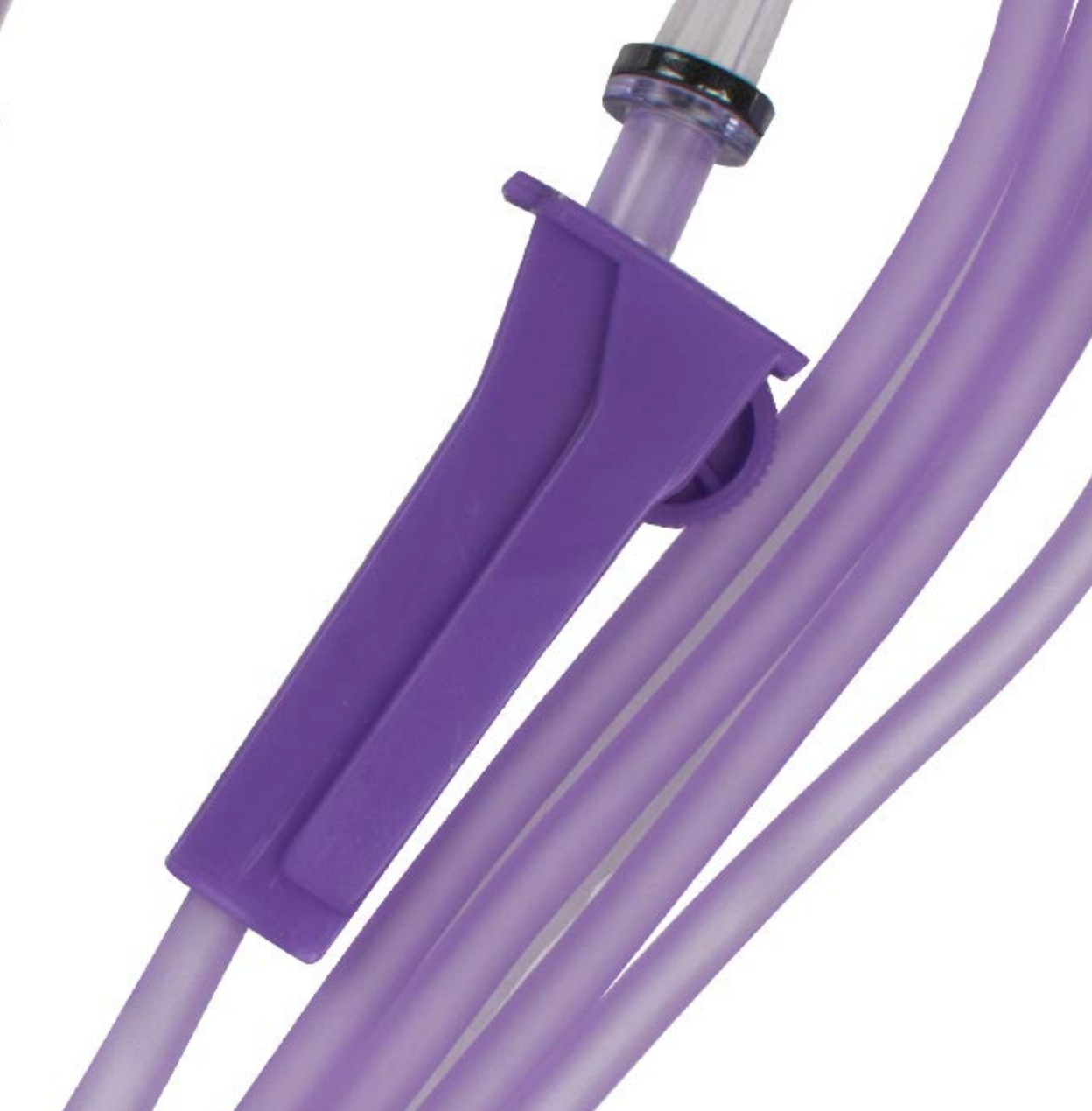
I purchased the bag, and in my mind that was it. I was using the bag for its intended use, slowly dispensing liquid, so the rest of the project could focus on the non-dynamic components of the piece.
Unfortunately, I had made an assumption about how slowly ink could be made to drip through a roller clamp. I have no medical experience, and I had assumed that these bags were used to administer relatively low-dose substances (on the order of 20 mL over an entire night). I was wrong. At the absolute minimum, I was able to get about one drop every 12 seconds, which was far, far faster than I wanted.
Why 12 seconds was too fast
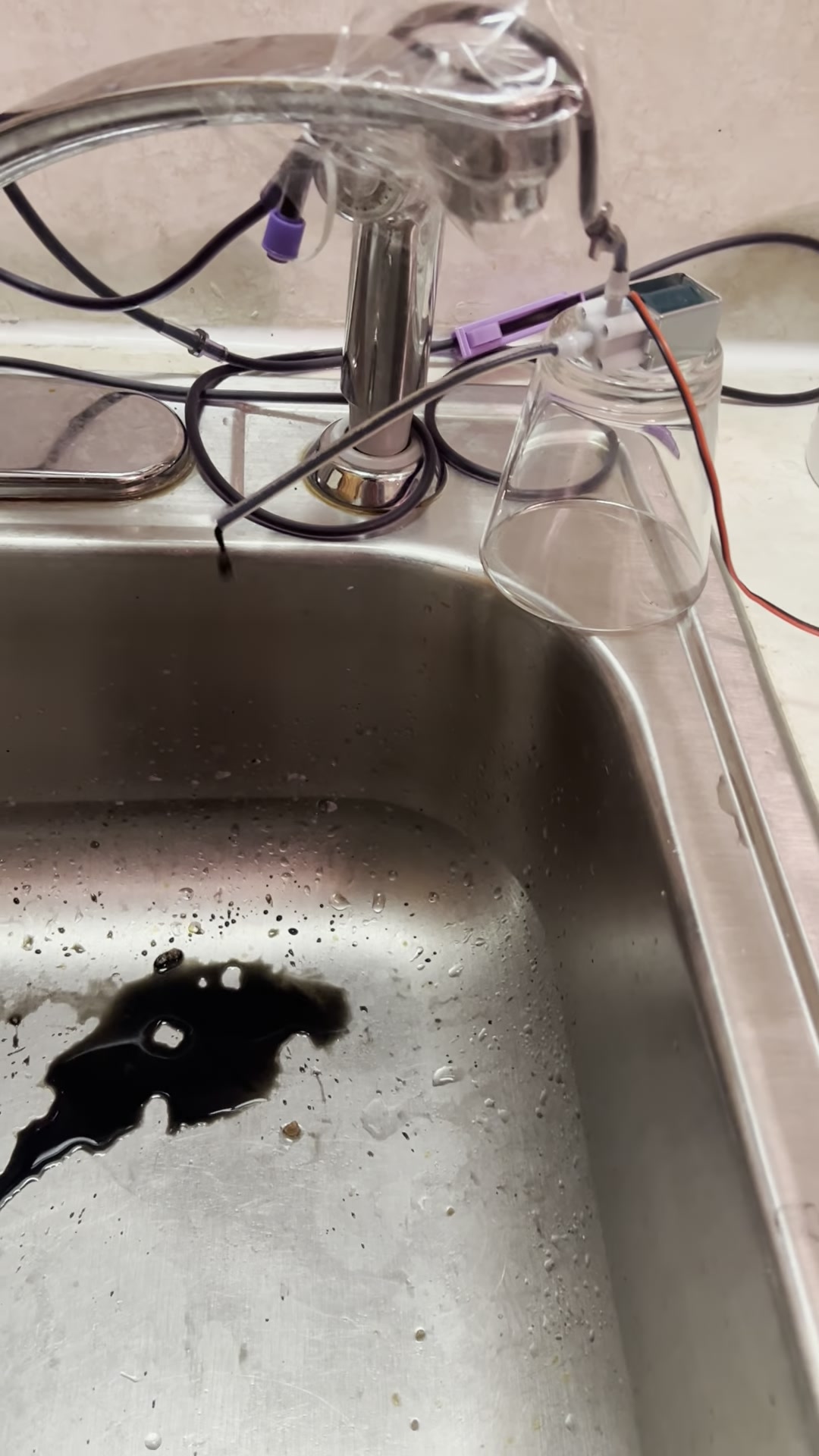
When running early experiments in my sink with just a Ziploc bag of ink, I really liked the look of single drops splattering against dry paper. However, when the ink dripped faster than it could dry, it created a pool (circled in red) that felt like a blemish.
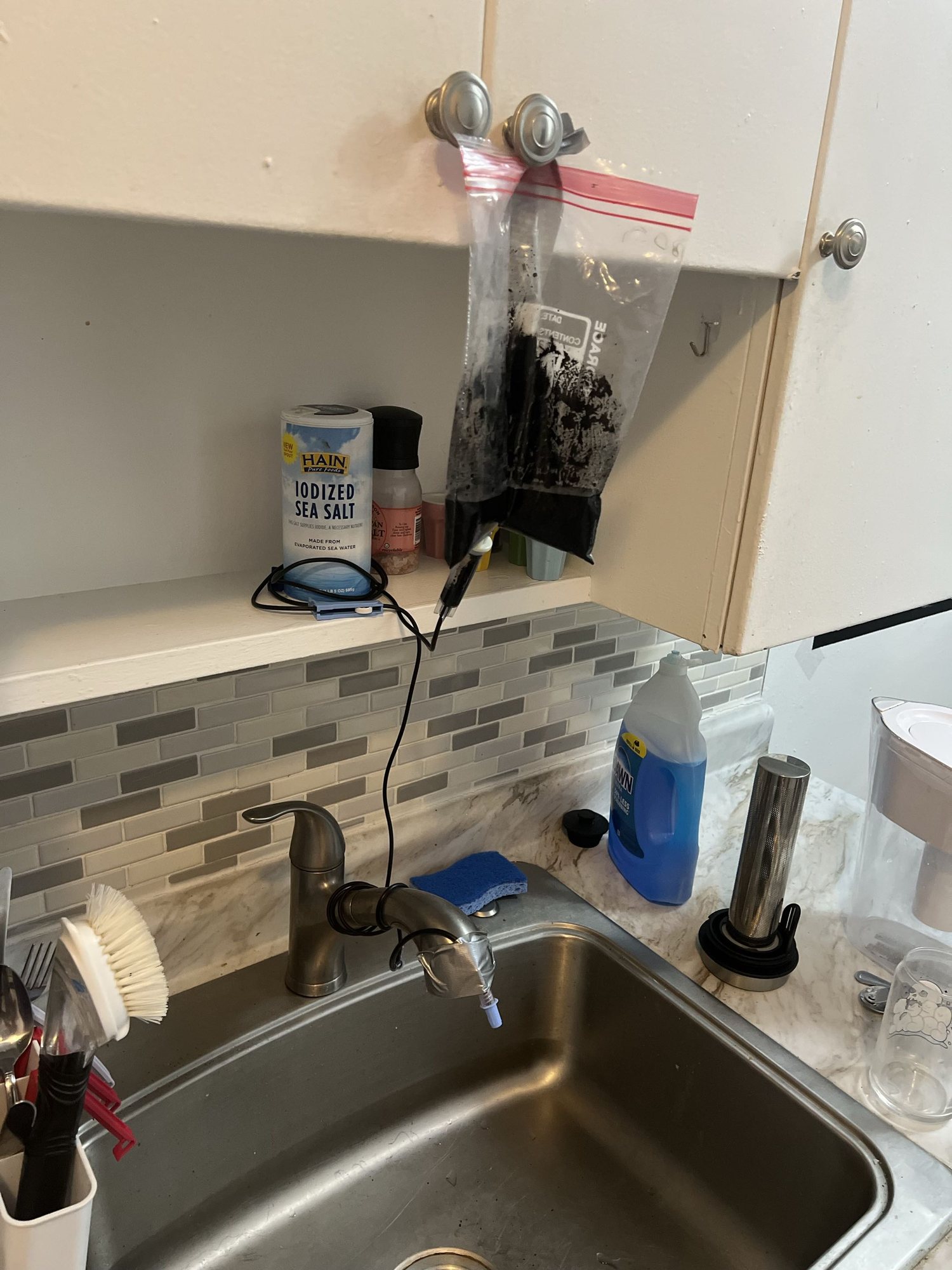
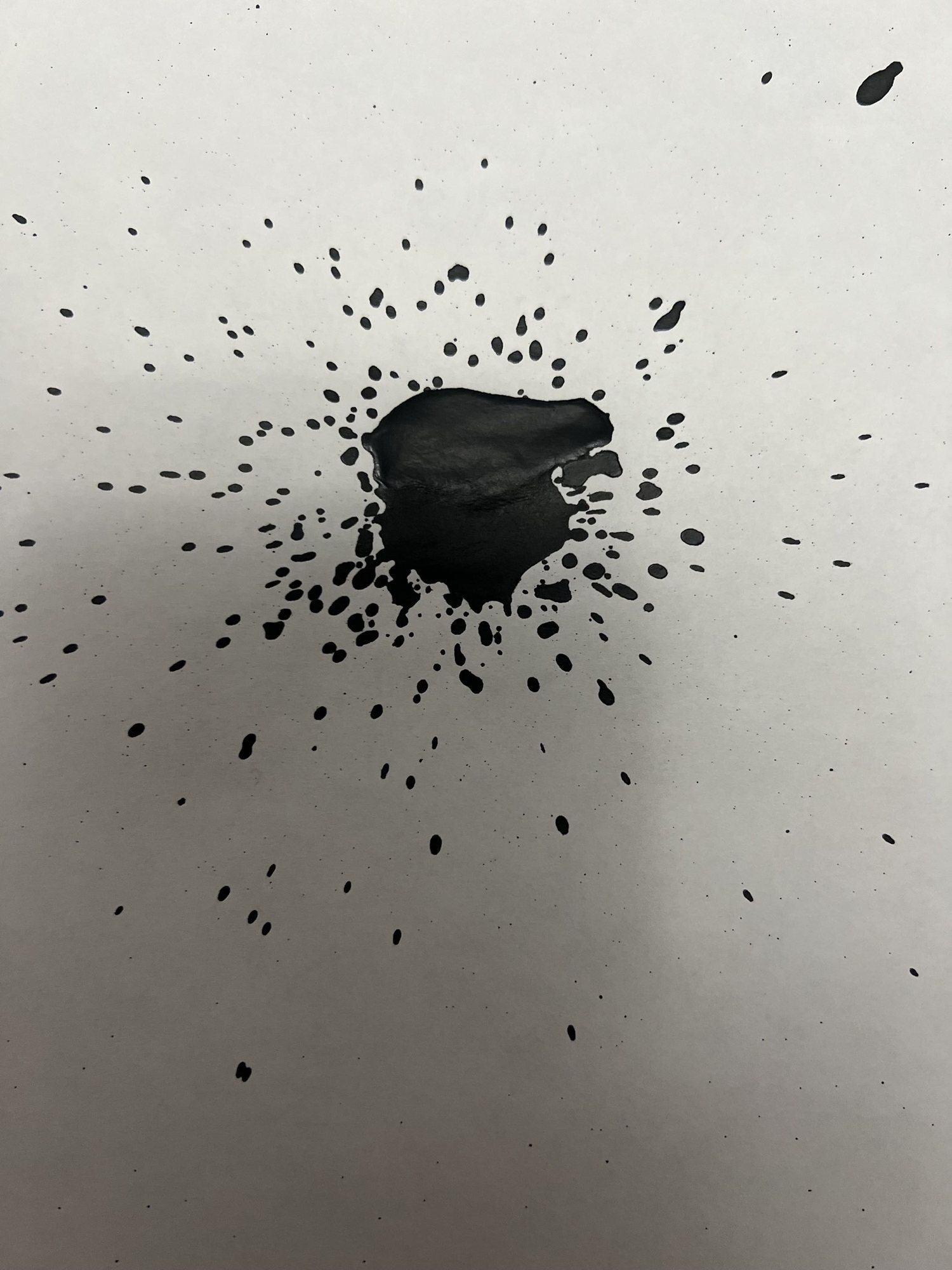
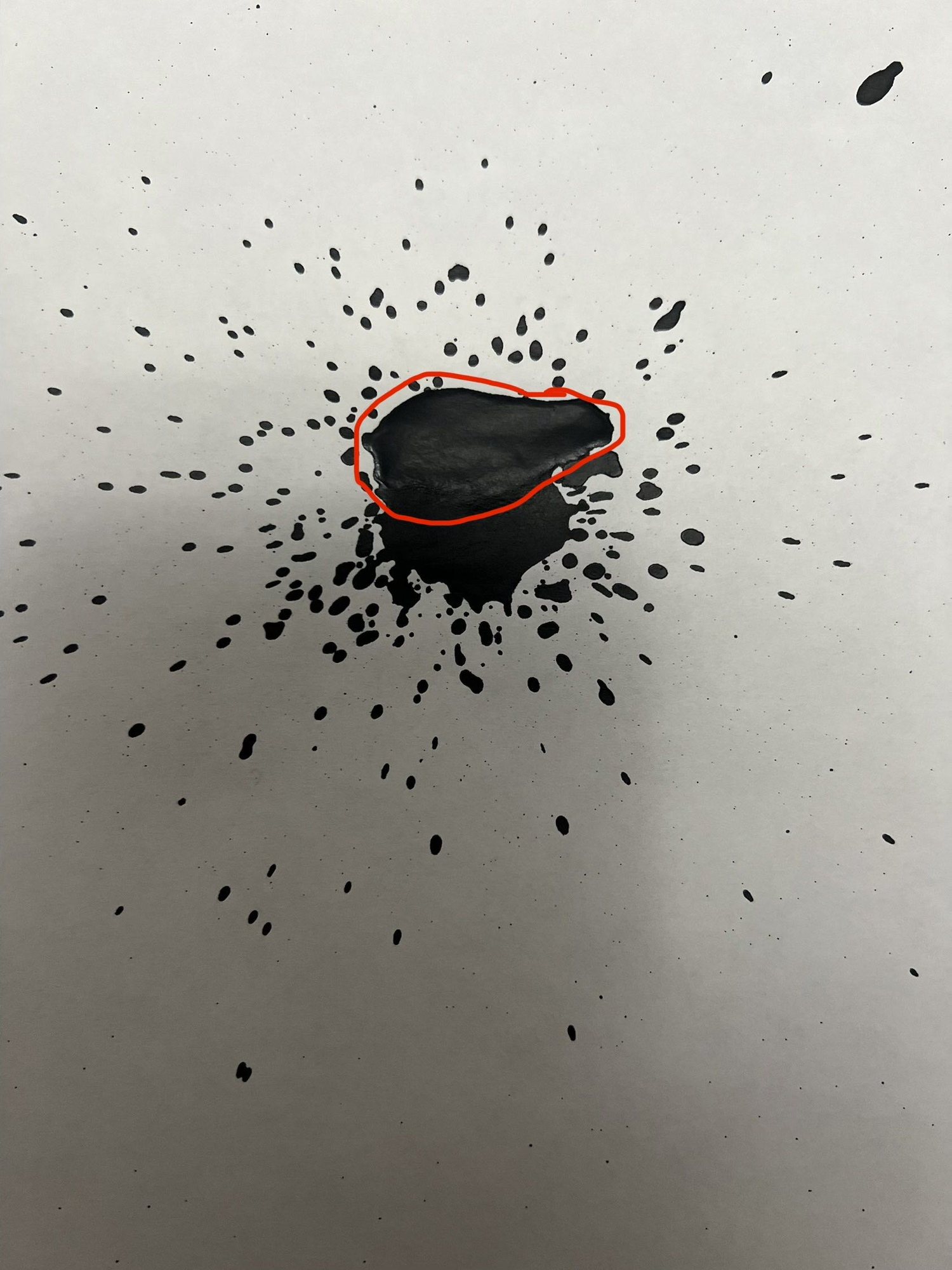
This motivated me to create a rate of dripping slower than the rate at which drops would dry. That way, each drop would strike and splatter on a dry surface rather than pooling and drying into a blemish. It takes on the order of 20 minutes for a drop to dry completely, so I wanted a system that released about one drop every 20 minutes. The roughly 12 seconds that the bag could pull off wouldn’t cut it.
Letting each drop dry before the next also determined how I prepared the ink. I diluted the ink by about 90%. That way, wherever two or more dried drops overlapped you could see it, because each additional drop made that spot appreciably darker.
One drop every 20 minutes would also make this a piece of long art. I would only get 72 drops a day and 504 a week, so the piece I envisioned would develop over months.
Cross-pollination from another project
I also wanted to be able to experiment with different drip rates without finagling a new physical solution each time. At this point, in October 2025, I was also building the initial prototype of my Paper Marbling Machine. That prototype had gravity-fed ink, and it released drops by rapidly opening and closing a solenoid valve to let a single drop through. I had already done the hard work of calibrating how long the solenoid needed to stay open relative to the amount of water pressure from the bag of pigment. I was also pretty lucky in that the ink I was using for Ink Drip had a similar viscosity to paper marbling pigment.
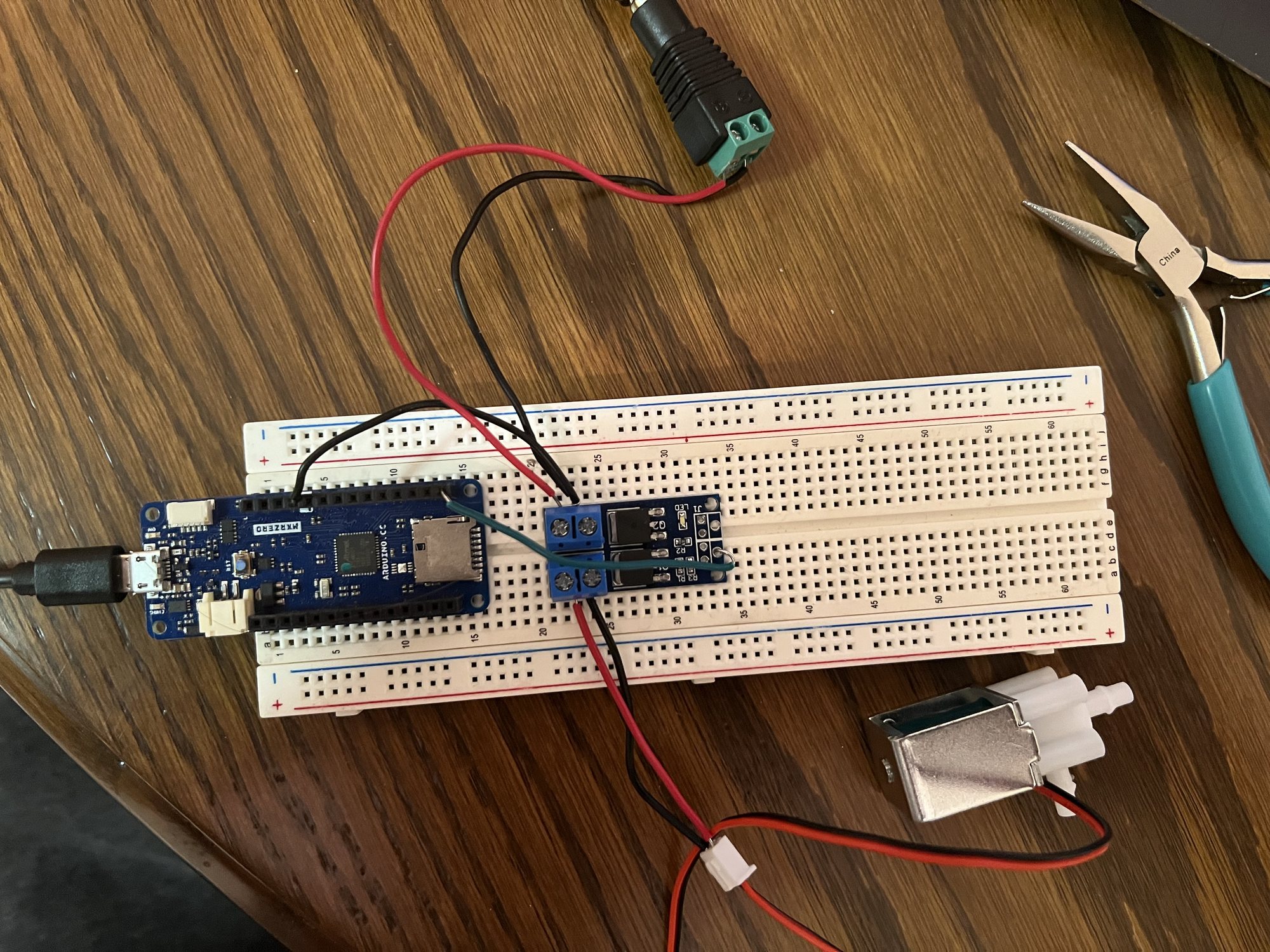
This was a fantastic opportunity for cross-pollination. Instead of needing to build and debug an entirely new physical system, I simply grabbed an extra S0626AV-D solenoid valve and XY-MOS MOSFET trigger switch that I had from my work on the Paper Marbling Machine, and scavenged an Arduino MKR Zero from a previous experiment.
The MKR Zero was actually a bad choice, and I would have used a different microcontroller if I’d had one lying around. It runs entirely at 3.3V, which is at the low end of the trigger voltage for the MOSFET. A 5V microcontroller would have been better. Thankfully, in this case the current was low enough for it not to matter. Here is the basic circuit all wired up:
With a simple timed high/low script on the Arduino, I was able to control how much ink was released through the system and how often:
At this point I had the fully functioning mechanism for the project, so I could officially turn my focus to designing the rest of the installation around it. From here on, this section focuses on the iterative design and artistic process that I took, and has few further technical details. This project was by design an experimental departure from my more technical projects.
Dress Rehearsal at the ArtLab
October 2025
I had the opportunity to install my piece in the Harvard ArtLab about a month ahead of the deadline, so I tried to create the final piece as I envisioned it, in order to get feedback and iterate on the design.
Leaving the mechanism exposed
In line with the goal of simplicity for this piece, I wanted to design it in a way that foregrounded the interaction of ink splattering onto a surface. Often, to foreground one aspect of an exhibition, artists will actively cover or hide the things that make that aspect possible (think invisible wire or curtains). For a physical interaction like this one, I wanted to take the opposite approach. Hiding the mechanism would add a layer of staging on top of the interaction, which felt more ostentatious to me than just leaving the mechanism exposed and visibly doing its job. To me, the piece was more about ink dripping on canvas if I did not hide the system that made that dripping possible.
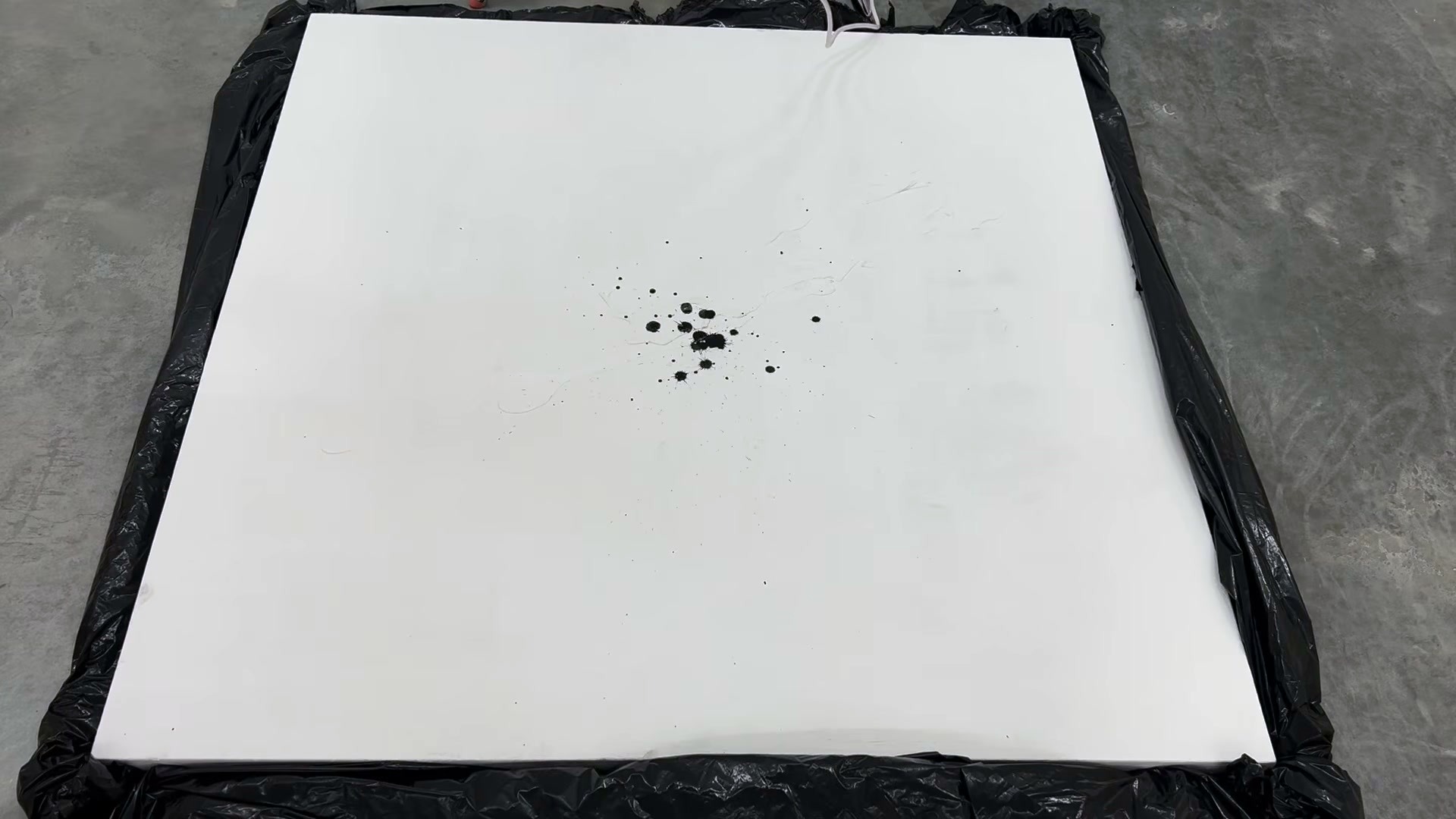
Here is the setup I landed on for the dress rehearsal:
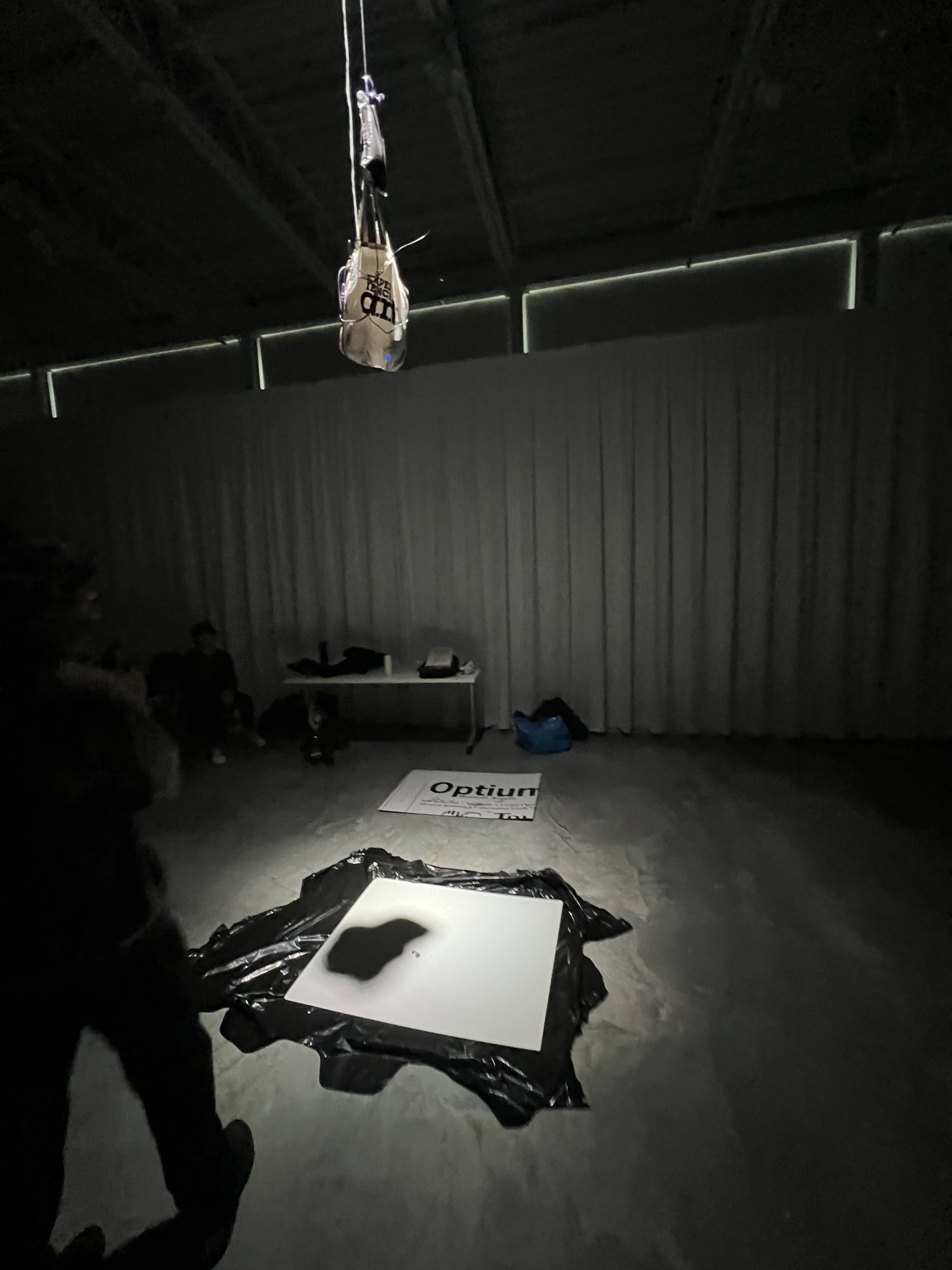
I kept the ink bag, the tubes, and the light from the electronics clearly visible. A spotlight above shone straight down onto the sheet of museum board that the ink dripped onto. The ink bag hung directly in the path between the spotlight and the board, so it cast a stark shadow.
Feedback
I was able to get a good amount of feedback on the design, and found a number of happy accidents as well as a number of things worth changing.
The click. Whenever the solenoid releases a drop of ink, it makes a mechanical clicking noise. I had been seeing that as a bit of a downside and was working on mitigating it. However, in a critique session, the consensus was that the click... plop of the solenoid opening and then the drop striking the board gave the piece an auditory component that it would otherwise be missing. This also goes along with my idea of the piece being as raw and honest about its mechanism as possible. If the solenoid has to make that noise for the mechanism to work, then the noise is a part of the piece and I don’t want to hide it.
The shadow. I found the dark blob of the bag’s shadow quite visually interesting. However, it was ultimately superfluous to the minimal interaction of ink dripping onto a surface, so keeping it would have gone against the idea of the piece.
The drip rate. I turned the rate of dripping up from once per 20 minutes to once per 10 seconds to better show off the system during the critique. The feedback I received was that the faster rate was much more engaging as a piece. This was a tough piece of feedback for me, because my initial vision for the piece was in the genre of long art. Going up to a drop every 10 seconds would change that completely.
Switching from Long Art to Overapplication
November 2025
This feedback put two of the most important parts of creativity for me into conflict: creating things that you believe in, and creating things that others find value in. The piece that I believed in was a long art piece, and that was the piece that other people told me was frankly boring. I ultimately decided to incorporate the feedback and run the ink dripper once per 10 seconds. (Ironically, a drop every 10 seconds is a rate that the roller clamp could have managed on its own.) However, that decision required a realignment of what the piece was about for me. This meant that I had to find something else in Ink Drip to believe in.
I landed on the idea of overapplication. I have made many pieces around the idea of marks on paper, such as Scribbler, Blick Typology, and Ball and Line, and something that fascinates me is when marks escape their substrate: when they rip or overwhelm the paper. With a faster rate of dripping and darker ink, I could begin to explore that theme while creating an installation that people found more engaging.
Note that the theme of a minimal system was not part of this realignment. Ink Drip was a minimal system both before and after it: ink drips onto a surface, and that is all. However, the “so what” of that minimal system, what that minimal system was achieving, shifted from long art to overapplication.
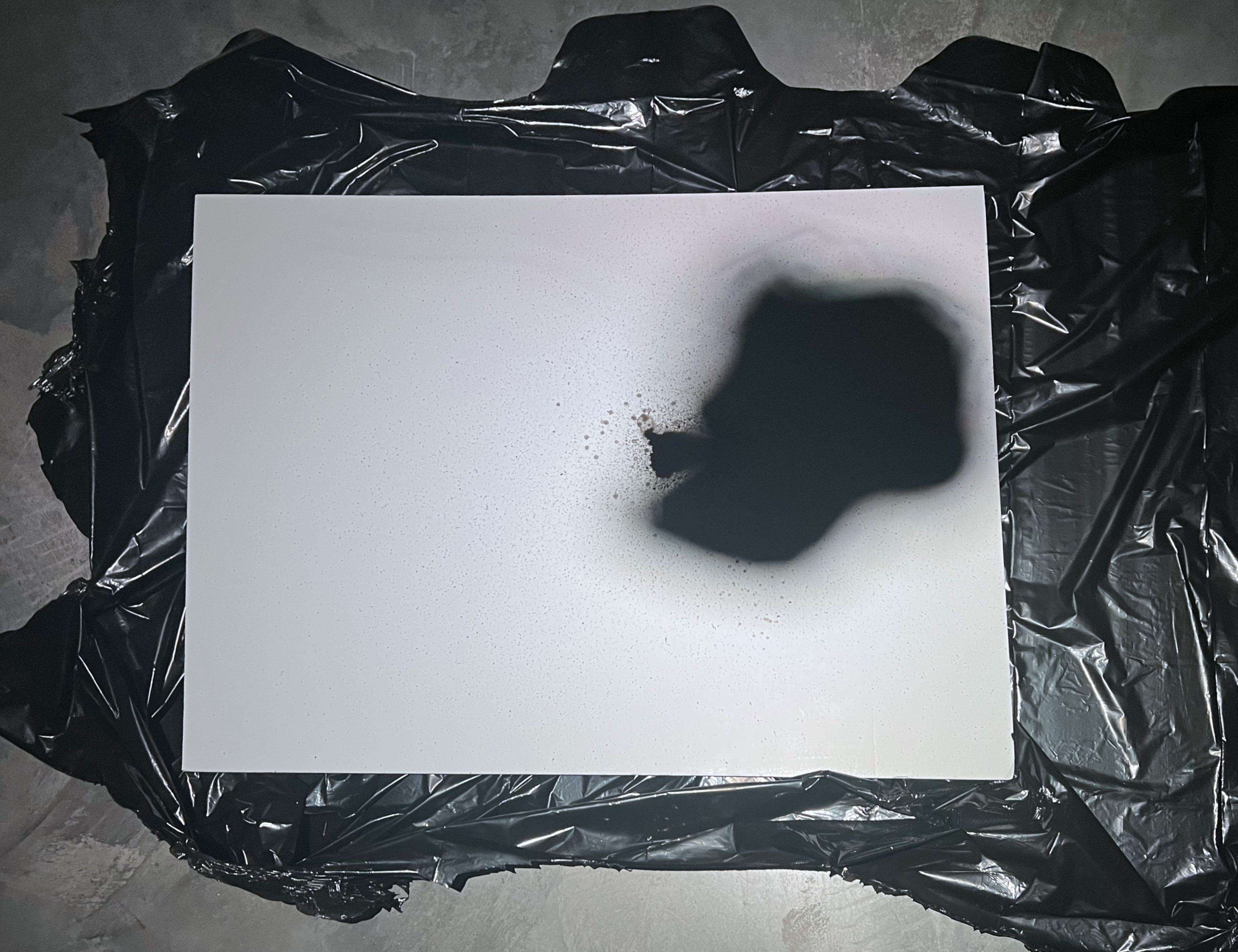
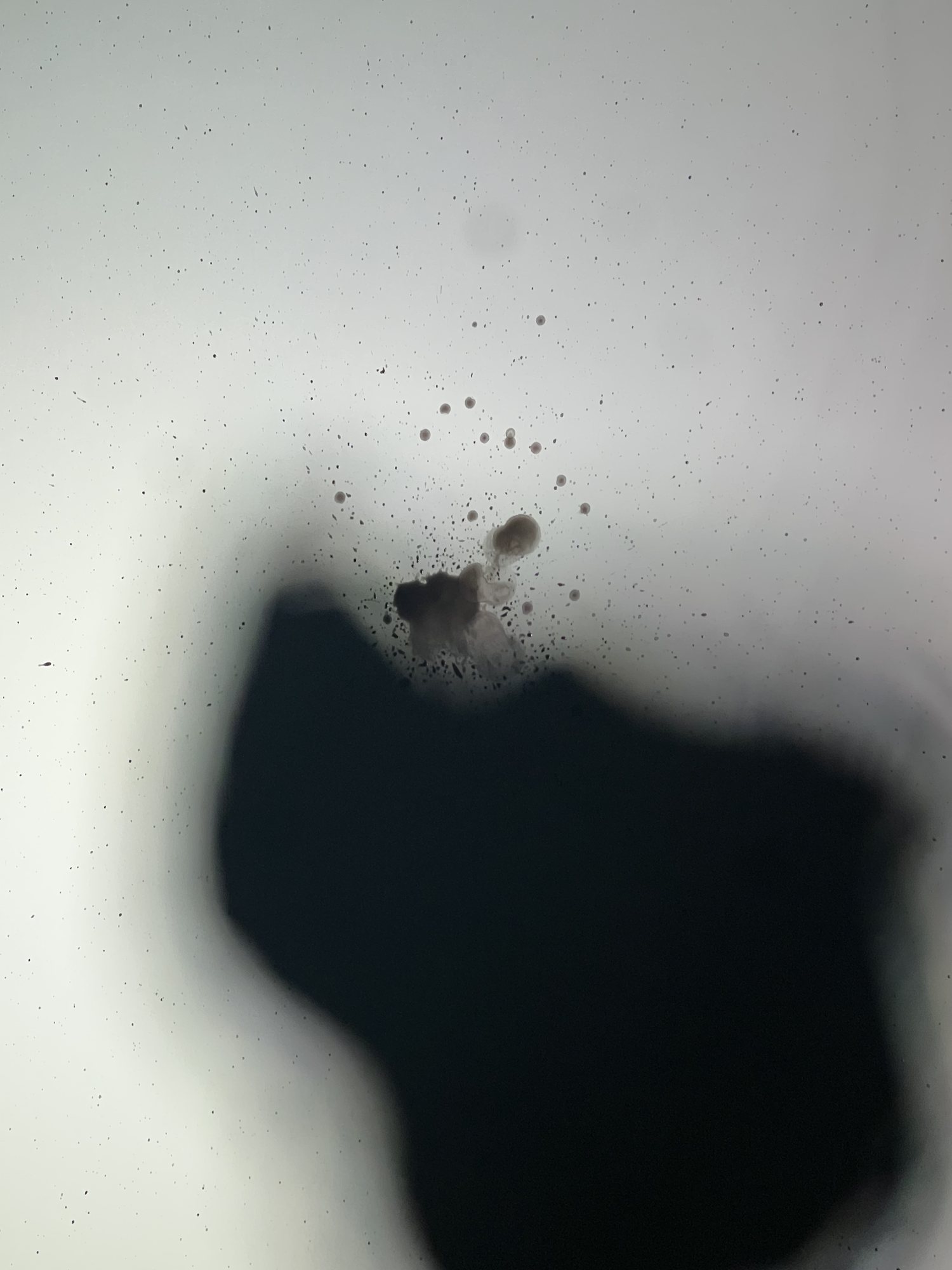
With the faster rate of dripping, it was unavoidable that ink would begin to pool in the center of the surface. However, within the new context of overapplication, the pool turned from a bad thing into a really cool thing! It no longer took away from a clean splattering pattern. Instead, the ink forming a pool on top of its substrate became even more interesting.
The pool also changed which ink made sense. I had diluted the ink for drops that dried before the next one landed. Now that the drops no longer dried in between, diluted ink would just form a pool of diluted ink rather than rounds of dried pigment on top of each other. So I switched to pure, uncut ink. For overapplication, maximum darkness made more sense: the idea is for the mark to overwhelm its substrate, and solid black ink “takes over” the canvas far more than diluted ink that still lets the canvas show through.
A New Canvas
December 2025
The pool also meant that I had to rework the surface that the ink was dripping onto. I swapped over from the museum board, which had a plasticy coating that absorbed very little ink, to a large, heavily gessoed canvas that I built. The gesso layer could absorb more ink, so the pool would form more slowly and a bit more of the ink would form a splattering pattern. The gesso was also waterproof enough to let the pool form without leaking through the canvas onto the floor beneath it.
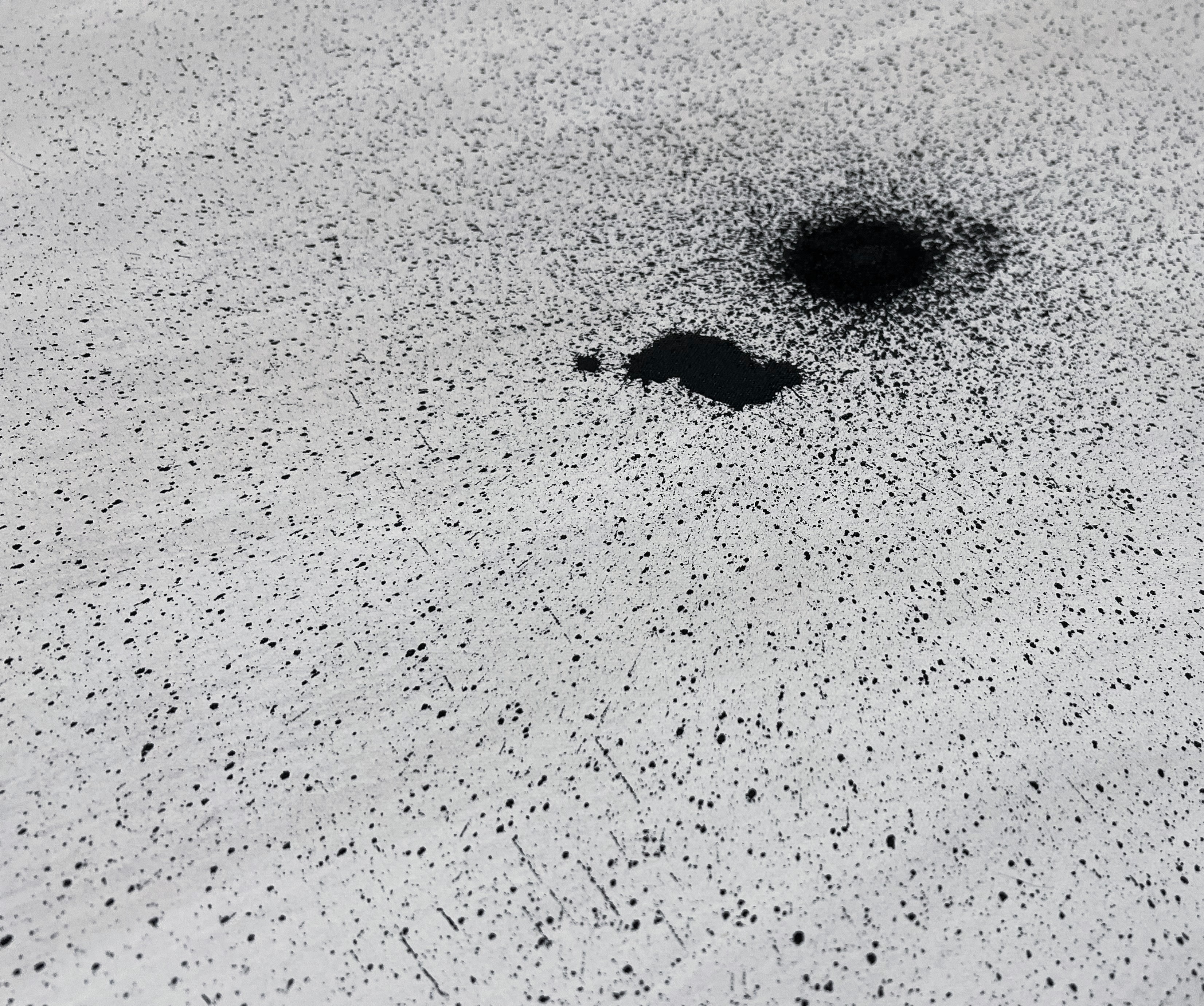
I experimented with different drop sizes (large on the left, small on the right):
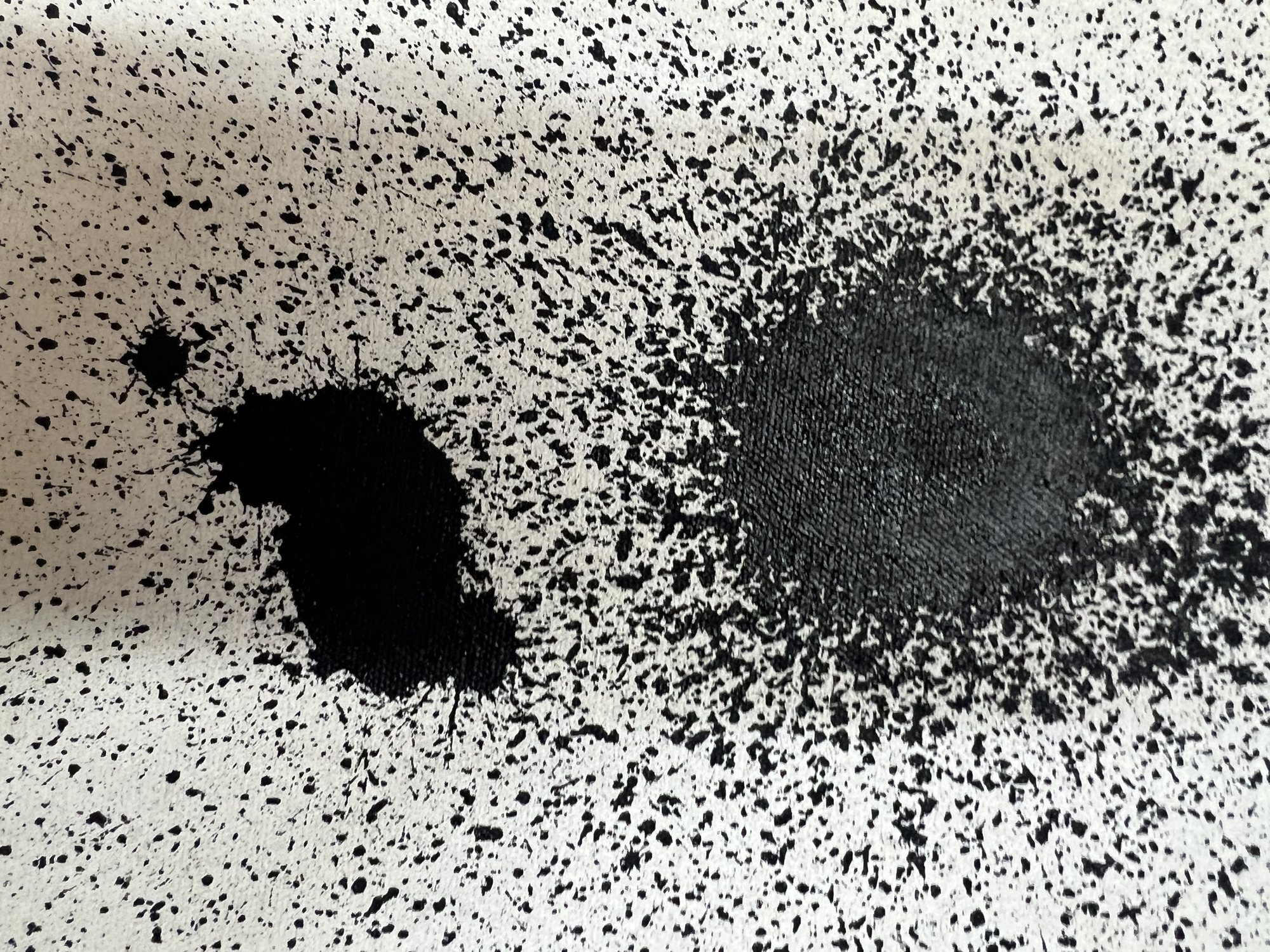
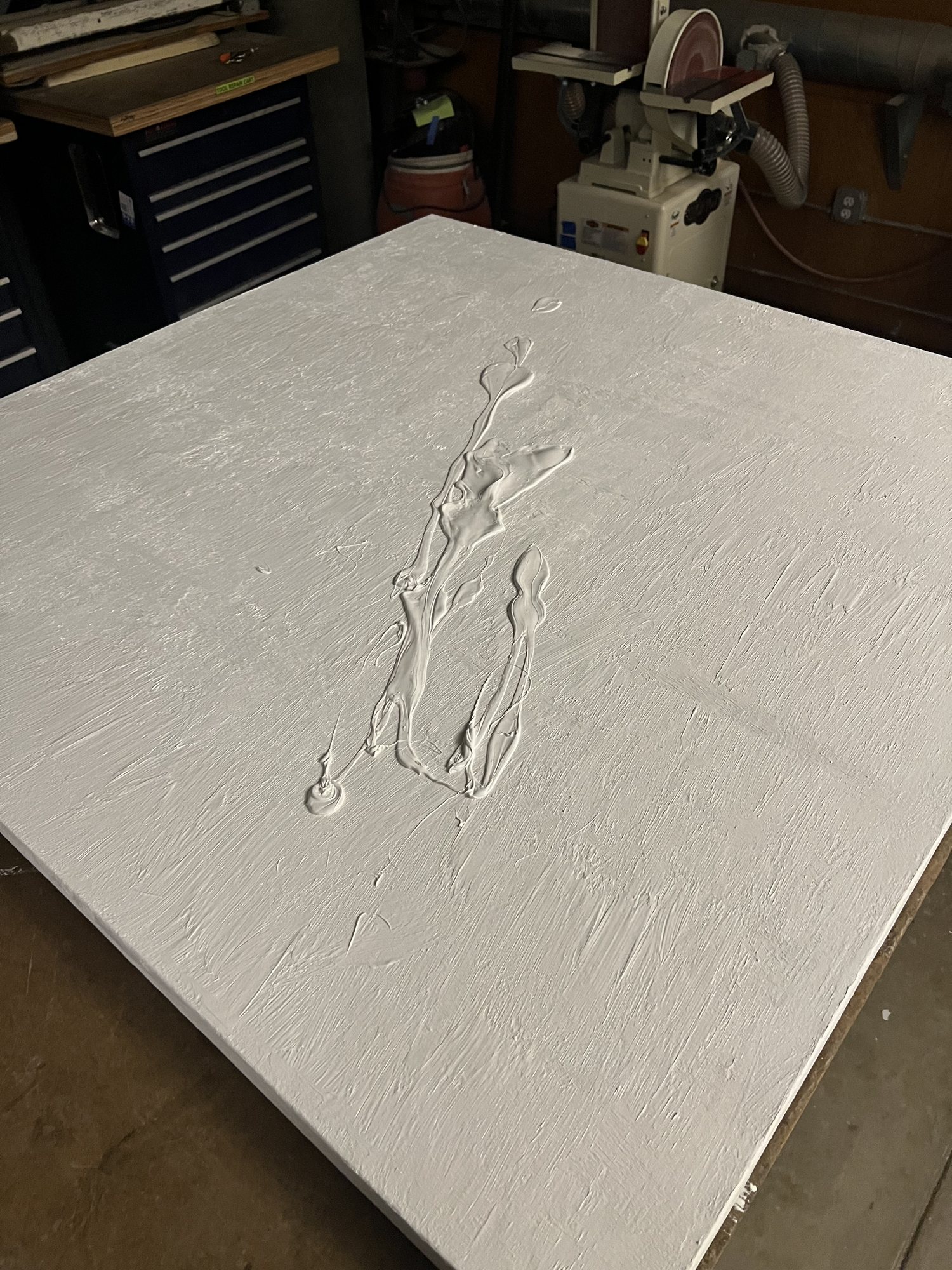
I also experimented with different applications of gesso. In one of them, I freely splattered an additional layer of gesso on top of a fresh coat, to add texture and to change how the ink flows when it lands on the textured part:
The Final Installation
December 2025
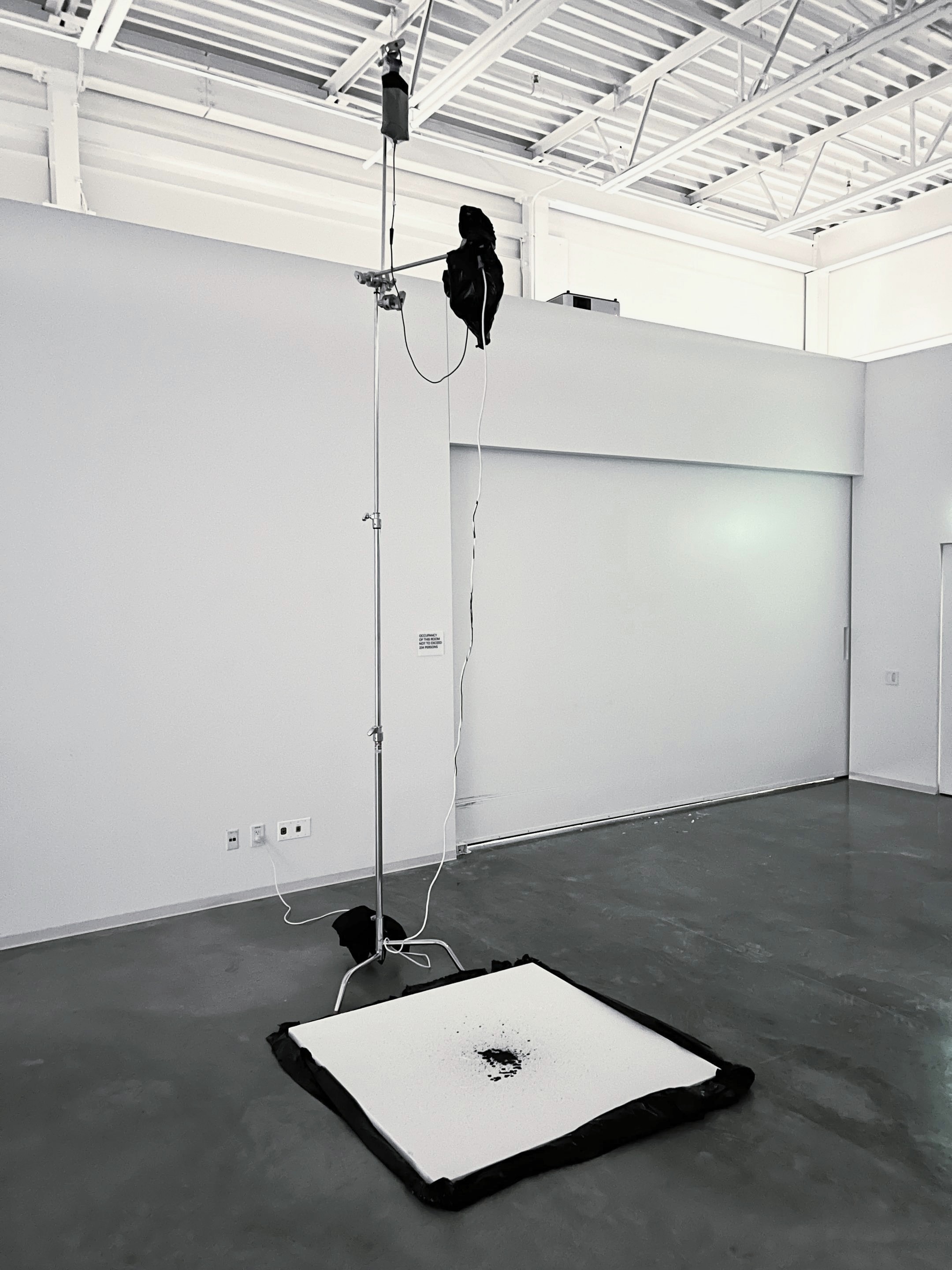
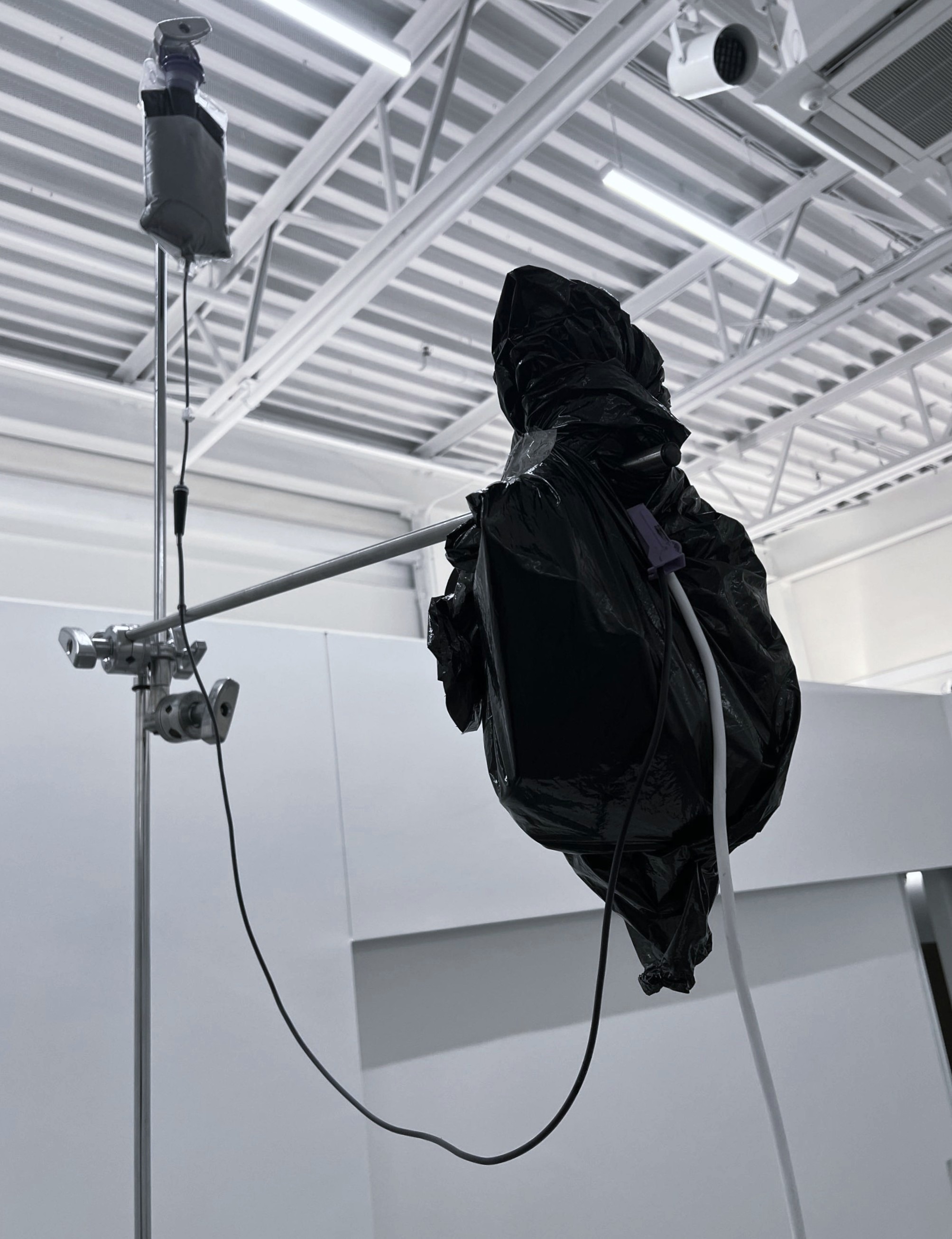
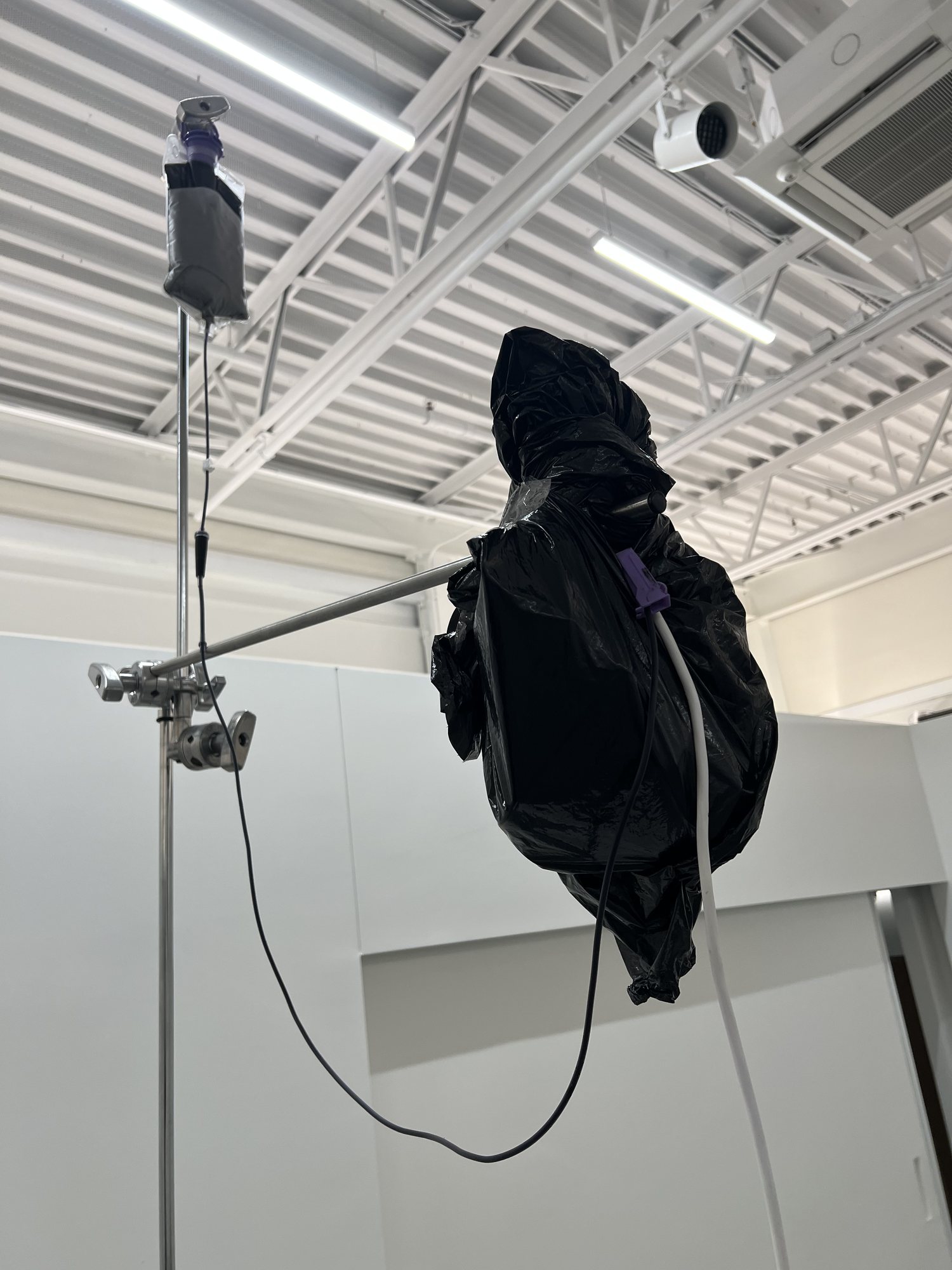
I eventually landed on a thick coat of gesso with a splattered texture, small drops coming down every 10 seconds, and a dripping mechanism that remained partially exposed from the bag that holds it. I also chose to let the power cord for the mechanism dangle in the path of the falling drops, where it sometimes gets hit by the ink, rather than keeping the cable off to the side and out of view.
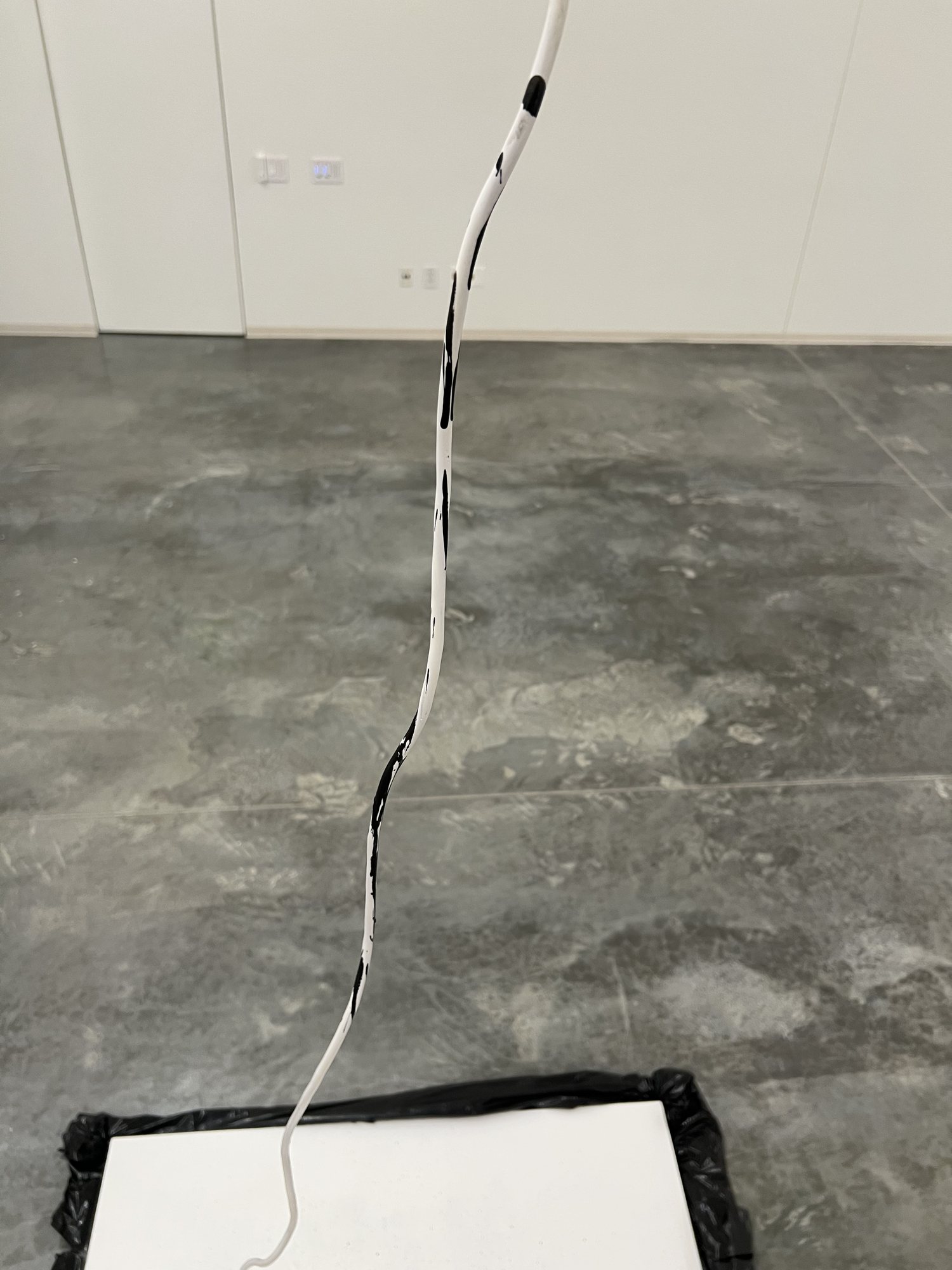
This was again done along the idea of keeping the functional components of the piece visible rather than hidden. This time, I am unsure whether it ultimately helped or harmed the piece. Yes, this was the most raw and untouched way of presenting the piece, but by disturbing the path of the ink falling onto the canvas I reintroduced complexity into a piece that is all about simplicity.
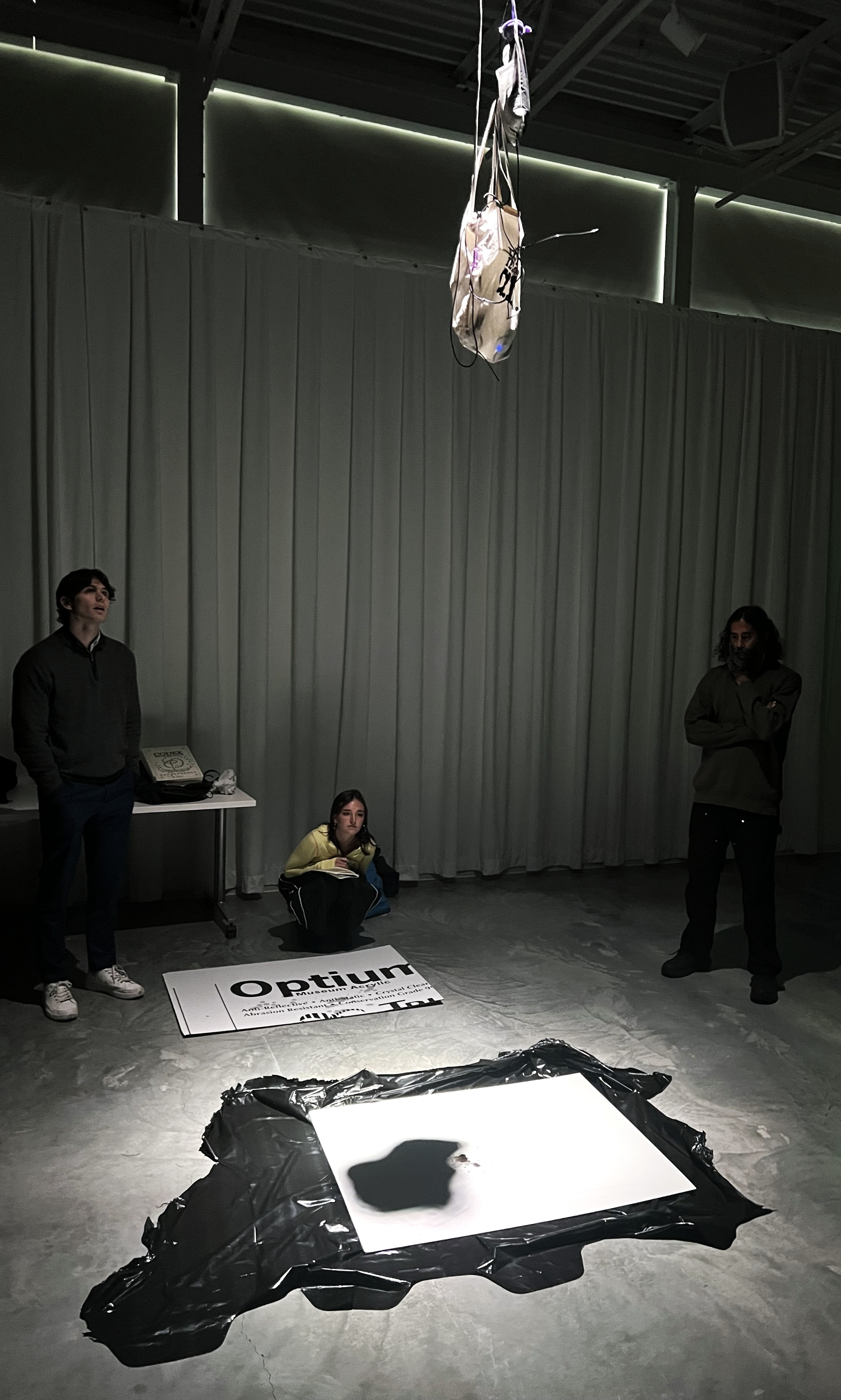
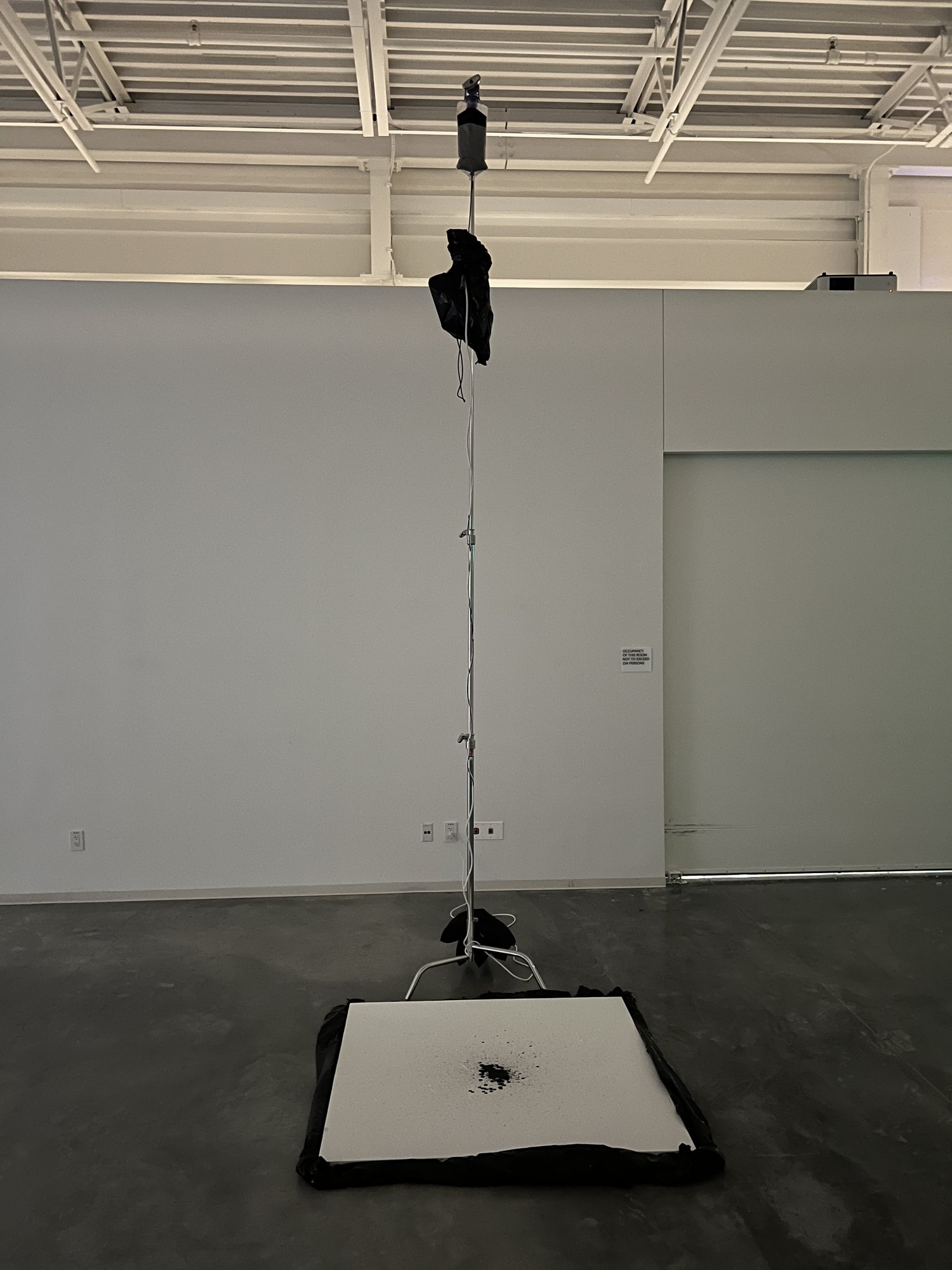
Beyond these points, the piece was kept largely the same. The ink bag was held visibly outside of the bag holding the electronics, both were suspended way above the canvas lying flat on the floor, and everything was kept within an extremely minimal color scheme and layout.
From the beginning, the piece was about both an installation and a permanent generative result, and I think the final version was able to achieve both goals. First, here is the installation with all the changes from the ArtLab dress rehearsal:
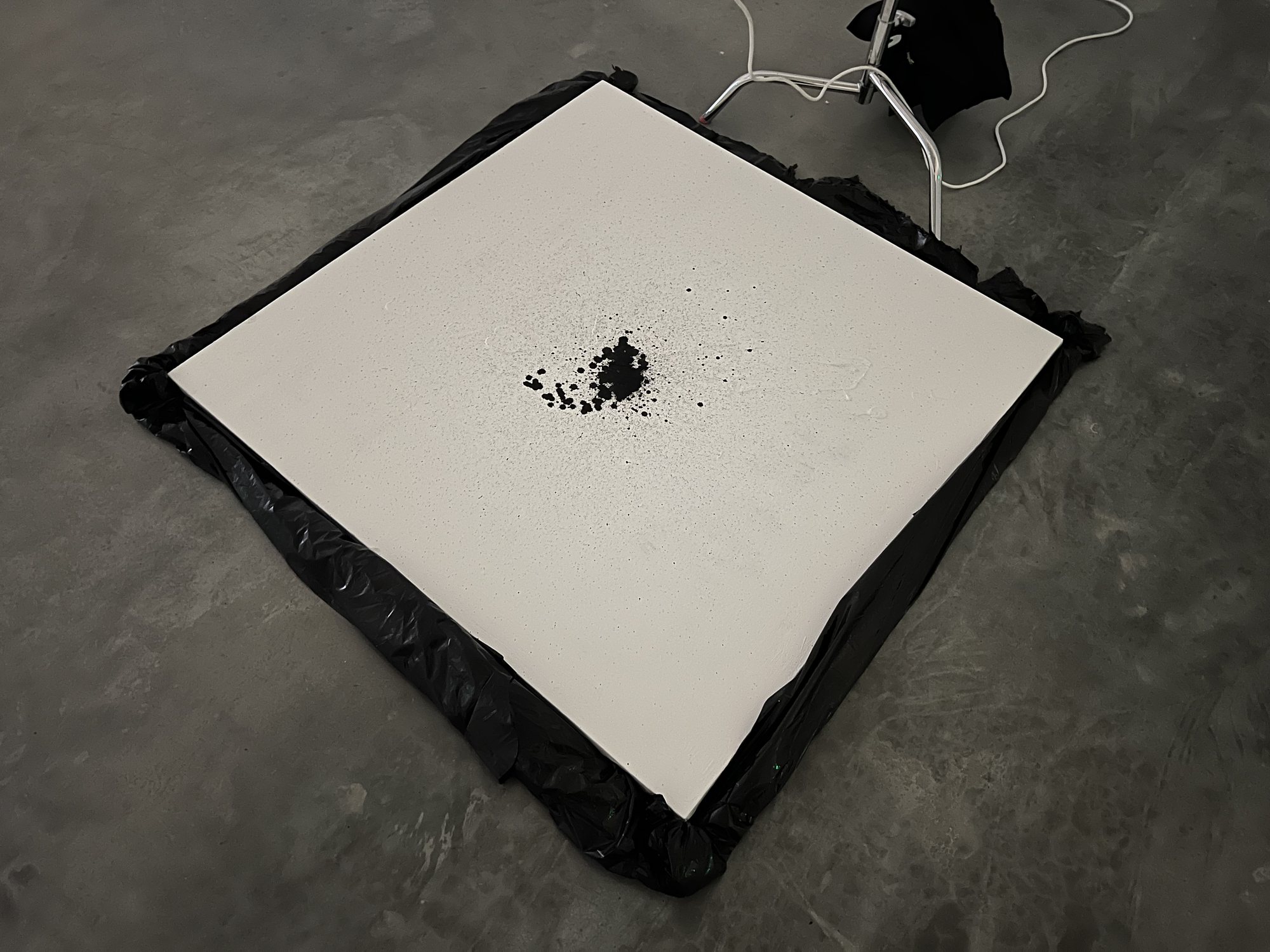
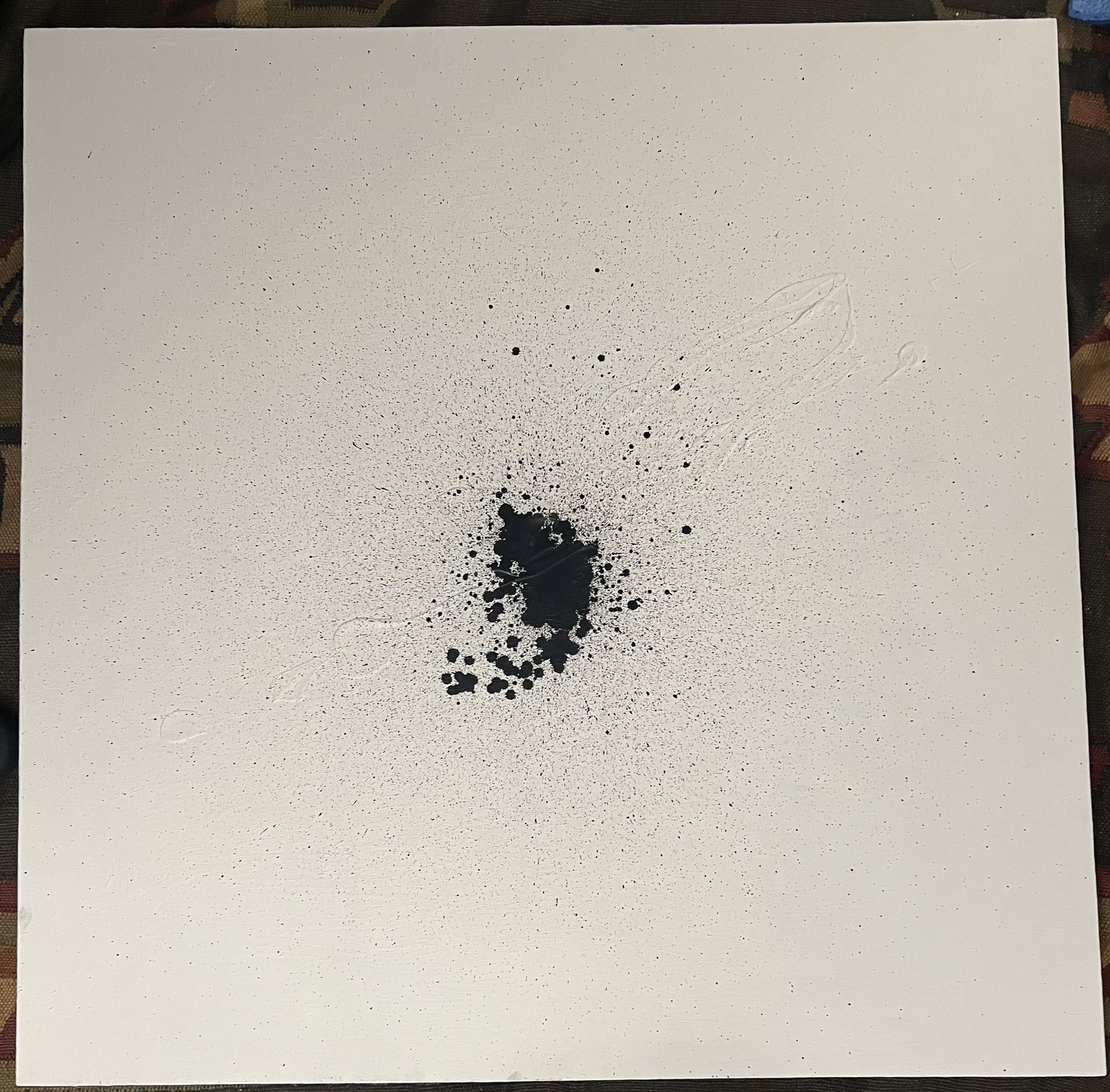
And here is the permanent result, the canvas that the installation left behind. For it, I went with the small drop size and the gesso layer that had texture on it: